
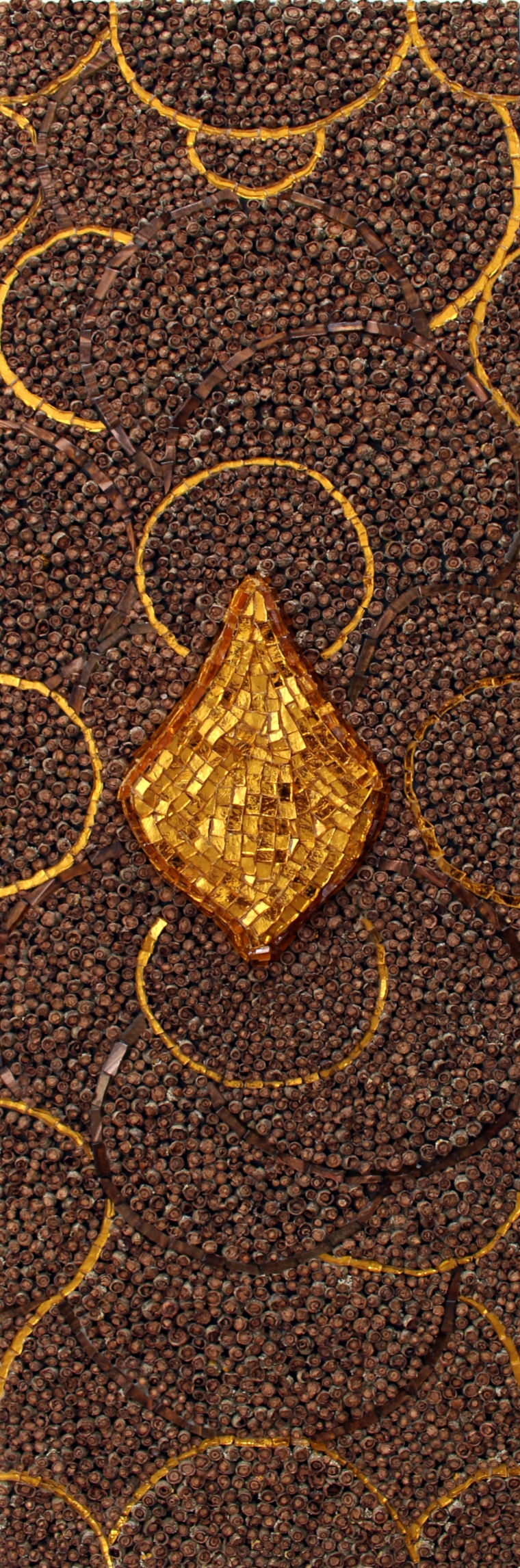
Infinito - vue générale

infinito - détail 1

Infinito - détail 2
Infinite / Infinito / Infini
Type / Tipo / Type: Mosaic picture / Quadro mosaico / Tableau mosaïque
Year / Anno / Année: 2026
Dimensions / Dimensioni / Dimensions
-
Height / Altezza / Hauteur (cm): 70
-
Width / Larghezza / Largeur (cm): 22,5
-
Depth / Profondità / Profondeur (cm): 4
Materials / Materiali / Matériaux
Mirrored glass, Venitian enamels, wood / Vetro spechhiato, smalti, legno / Verre miroir, émaux vénitiens, bois
Iconology / Iconologia / Iconologie
INFINITO is built from more than two thousand small wooden cylinders, each cut by hand by the artist, all identical in diameter and height and set to show their cross-section. The text sees a radical choice here: in mosaic, the tessera no longer serves the image but becomes the thought of the work itself.
The growth rings make time visible: each circle is one year of the tree's life, and the multitude of cylinders forms an archive of infinity. Unlike stone, glass or ceramic, wood is organic, lived time. Cutting it by hand, two thousand times, turns the gesture into a ritual, like the sand mandalas of Tibetan monks.
A paradox runs through the work: the serial perfection of the form, close to the rigour of Donald Judd and Sol LeWitt, reveals by contrast the uniqueness of the material. Each cylinder has its own grain and tint, like a choir singing one note in which two thousand timbres vibrate. The work thus joins Parmenides' One and Heraclitus' becoming.
The tall vertical format, close to a stele, expresses an upward reach. Across this warm, vibrating field, broad golden curves draw a cosmology of arcs, orbits and almond shapes, recalling mandalas and Dante's celestial spheres. At the centre, a diamond of gilded glass smalti catches the light and changes with the viewer's gaze: a cosmic seed from which everything seems to radiate and to which everything seems to return.
The wooden field is Leopardi's hedge: the limit becomes a threshold to the limitless. Trained in Ravenna, the artist extends the gold tradition of Galla Placidia without imitating it: where the Byzantines evoked an eternity outside time, wood carries infinity as the transfiguration of time.
INFINITO è costruito con oltre duemila piccoli cilindri di legno, tagliati a mano uno ad uno dall'artista, tutti identici per diametro e altezza e posati in modo da mostrare la sezione trasversale. Il testo vi vede una scelta radicale: nel mosaico la tessera non è più al servizio dell'immagine, ma diventa il pensiero stesso dell'opera.
Gli anelli di crescita rendono visibile il tempo: ogni cerchio è un anno di vita dell'albero, e la moltitudine dei cilindri forma un archivio dell'infinito. A differenza della pietra, del vetro o della ceramica, il legno è tempo organico e vissuto. Tagliarlo a mano, duemila volte, trasforma il gesto in rito, come i mandala di sabbia dei monaci tibetani.
Un paradosso attraversa l'opera: la perfezione seriale della forma, vicina al rigore di Donald Judd e Sol LeWitt, rivela per contrasto l'unicità della materia. Ogni cilindro ha le proprie venature e la propria tinta, come un coro di voci all'unisono dove vibrano duemila timbri. L'opera unisce così l'Uno di Parmenide e il divenire di Eraclito.
Il formato verticale, simile a una stele, esprime lo slancio verso l'alto. Su questo campo caldo e vibrante, grandi curve dorate disegnano una cosmologia di archi, orbite e mandorle, richiamando i mandala e le sfere celesti di Dante. Al centro, un rombo in smalti dorati cattura la luce e muta con lo sguardo: seme cosmico da cui tutto sembra irradiarsi e verso cui tutto sembra tornare.
Il campo di legno è la siepe di Leopardi: il limite diventa soglia verso l'illimitato. Formata a Ravenna, l'artista prolunga la tradizione dell'oro di Galla Placidia senza imitarla: dove i bizantini evocavano un'eternità fuori dal tempo, il legno porta l'infinito come trasfigurazione del tempo.
INFINITO est construit avec plus de deux mille petits cylindres de bois, taillés à la main un par un par l'artiste, tous identiques en diamètre et en hauteur et posés de façon à montrer leur section transversale. Le texte y voit un choix radical : dans la mosaïque, la tessère ne sert plus l'image, elle devient la pensée même de l'œuvre.
Les cernes de croissance rendent le temps visible : chaque cercle est une année de vie de l'arbre, et la multitude des cylindres forme une archive de l'infini. Contrairement à la pierre, au verre ou à la céramique, le bois est un temps organique et vécu. Le tailler à la main, deux mille fois, transforme le geste en rite, comme les mandalas de sable des moines tibétains.
Un paradoxe traverse l'œuvre : la perfection sérielle de la forme, proche de la rigueur de Donald Judd et de Sol LeWitt, révèle par contraste l'unicité de la matière. Chaque cylindre porte ses propres veines et sa propre teinte, comme un chœur à l'unisson où vibrent deux mille timbres. L'œuvre réunit ainsi l'Un de Parménide et le devenir d'Héraclite.
Le format vertical, proche de la stèle, exprime l'élan vers le haut. Sur ce champ chaud et vibrant, de grandes courbes dorées dessinent une cosmologie d'arcs, d'orbites et d'amandes, qui rappelle les mandalas et les sphères célestes de Dante. Au centre, un losange en émaux dorés capte la lumière et change avec le regard : graine cosmique d'où tout semble rayonner et vers laquelle tout semble revenir.
Le champ de bois est la haie de Leopardi : la limite devient seuil vers l'illimité. Formée à Ravenne, l'artiste prolonge la tradition de l'or de Galla Placidia sans l'imiter : là où les Byzantins évoquaient une éternité hors du temps, le bois porte l'infini comme transfiguration du temps.